Decoding the Label: What Tea Certifications Actually Mean
Fairtrade, Rainforest Alliance, USDA Organic, Demeter Biodynamic — a plain-language field guide to the ten certifications you'll see on tea packaging, what each one demands of producers, and what it really means for your cup.
Sameera
May 22, 2026 · 12 min read
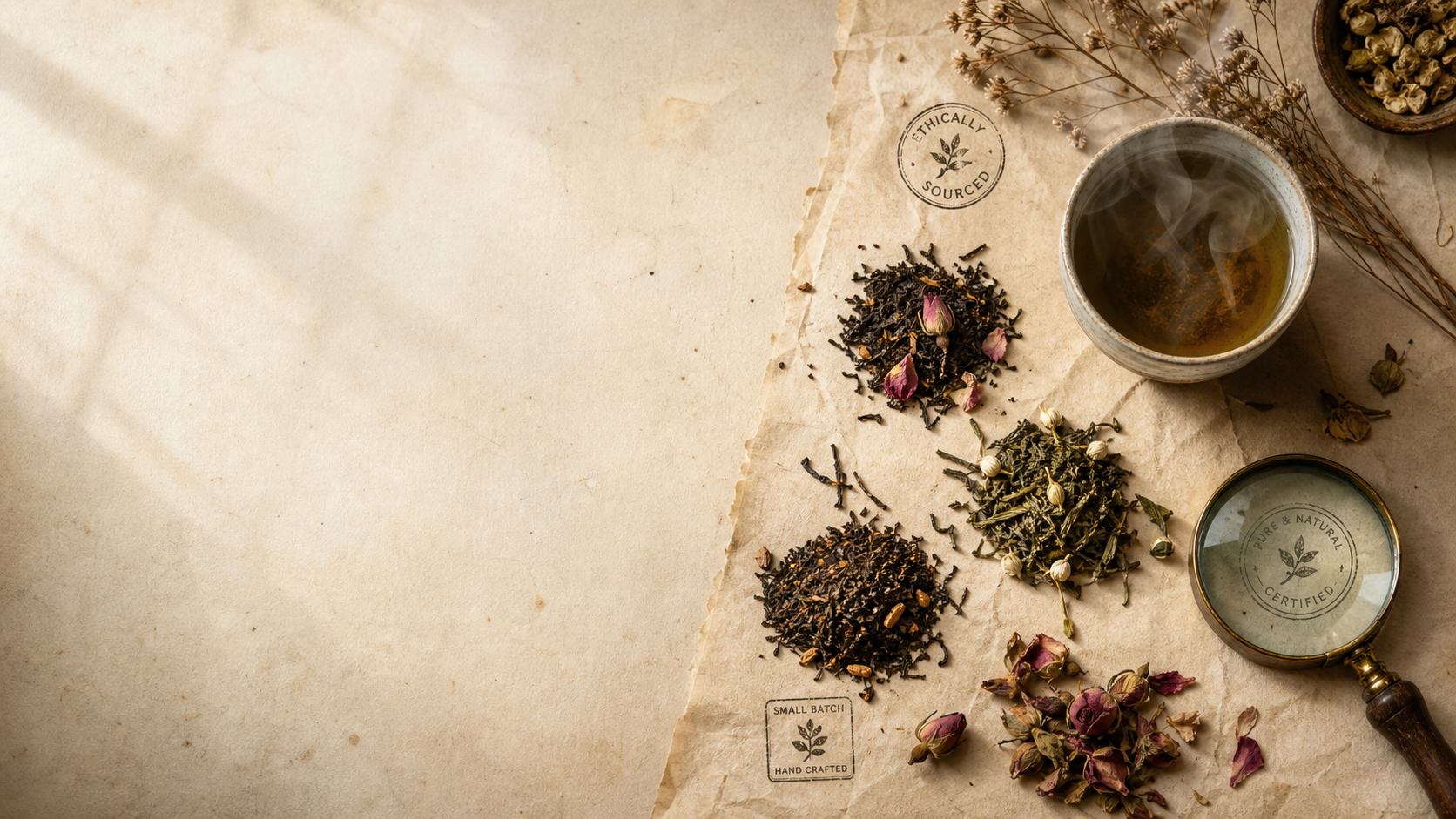
You're standing in the tea aisle. Or scrolling through an online shop at midnight, guided only by instinct and a vague craving for something smoky from Yunnan. Your eyes drift to the packaging — and there they are: a parade of small, earnest logos. A frog. A pair of hands. A checkmark inside a circle. A sun over a tree.
What do they all mean? And more importantly — does any of it matter to what's in your cup?
The short answer: yes, quite a lot, actually. These certifications are a compressed language. Each one encodes a set of promises — about the environment where your tea was grown, the wages paid to the people who picked it, the chemicals (or lack thereof) used along the way. Learning to read them is one of the most practical things a tea drinker can do.
*Every label is a story told in shorthand — learn the alphabet, and the whole supply chain opens up.*
What follows is your field guide: a plain-language breakdown of the most significant certification labels you'll encounter on tea packaging globally, what each one demands of producers, and what it means for you as a consumer.
---
**1. Fairtrade — Fairtrade International (FLO)**
One of the most recognised symbols in the world of ethical trade, the Fairtrade mark is managed by Fairtrade International and its network of national organisations. For tea, it means that farmers and workers receive a guaranteed minimum price for their crop — a price designed to cover sustainable production costs — plus a Fairtrade Premium: extra money paid directly to producer communities to invest in education, healthcare, or farming improvements as they see fit.
Fairtrade also sets standards on safe working conditions, prohibits child and forced labour, and encourages environmentally sustainable farming practices. You'll find this label prominently on teas from Kenya, India, Sri Lanka, and increasingly from smaller origin countries.
*What it tells you:* The people who grew your tea were paid fairly, and their communities received extra investment. It is primarily a social and economic certification.
**Key promises:** Worker welfare · Price guarantee · Community investment · Most common in Kenya, India, Sri Lanka.
---
**2. Rainforest Alliance — Rainforest Alliance Certified™**
Recognised by its cheerful green frog, this certification is one of the most widely used on tea packaging globally. The Rainforest Alliance merged with UTZ in 2018, creating a combined standard that addresses both environmental and social concerns together rather than separately.
For tea farms, achieving this seal means meeting rigorous criteria across biodiversity conservation (protecting natural habitats and wildlife corridors), climate resilience (managing water, soil, and carbon responsibly), and human rights (fair wages, safe conditions, no child labour). The standard uses a tiered scoring system, so farms that score higher unlock better market access and premium pricing incentives.
*What it tells you:* This tea was grown on a farm that met verifiable environmental and social benchmarks. The frog is a genuine indicator of holistic responsibility — not just one or the other.
**Key promises:** Biodiversity · Climate resilience · Worker rights · Now incorporates the former UTZ programme.
---
**3. USDA Organic — United States Department of Agriculture**
The green-and-white USDA Organic seal is probably the most recognisable organic label in the world, and it carries significant weight even on imported teas sold in American markets. To carry this label, tea must be grown without synthetic pesticides, herbicides, or fertilisers for at least three years prior to certification, and processed without prohibited additives.
It does not, on its own, say anything about worker pay or social conditions — that's an important distinction. But it does offer a meaningful assurance about what isn't in your cup, and what the soil, water, and surrounding ecosystem weren't exposed to during production.
*What it tells you:* The tea was grown without synthetic chemicals. Strong environmental reassurance, especially for people concerned about pesticide residues or supporting regenerative farming.
**Key promises:** No synthetic pesticides · No synthetic fertilisers · Required for the US organic market · Does not cover social standards.
---
**4. EU Organic Leaf — European Union Organic Regulation (EC 834/2007 & 848/2018)**
The EU's own organic logo — a white leaf composed of stars on a green background — is mandatory on all pre-packaged organic food sold within the European Union. For tea entering the EU market from countries like China, Japan, India, or Kenya, producers must comply with standards that are broadly equivalent to the EU Organic Regulation, or obtain equivalency recognition.
Like USDA Organic, the focus is on chemical-free agricultural practices: no prohibited synthetic inputs, no GMOs, and maintenance of soil health. The EU regulation is particularly strict on traceability and third-party inspection. Many Japanese ceremonial-grade teas carry this seal alongside domestic Japanese Agricultural Standards (JAS) organic certification.
*What it tells you:* Equivalent assurance to USDA Organic, but validated for the European market. Essential reading for EU-based tea drinkers.
**Key promises:** No GMOs · Chemical-free farming · Mandatory in EU · Common on imports from Japan, India, Kenya.
---
**5. JAS Organic — Japanese Agricultural Standards (Organic)**
Japan has its own rigorous organic certification framework managed by the Ministry of Agriculture, Forestry and Fisheries (MAFF). The JAS Organic label is awarded to teas produced without synthetic chemical inputs, grown from non-GMO seed, and processed without prohibited additives or synthetic preservatives.
Japanese organic certification is highly respected globally — the standards are meticulous, inspection processes are stringent, and the cultural weight behind *shizen saibai* (natural cultivation) is profound in Japan's tea growing communities. For matcha, gyokuro, and sencha drinkers in particular, this label is a trusted indicator of clean, carefully cultivated leaf.
*What it tells you:* Particularly meaningful for Japanese teas. A JAS label signals adherence to Japan's own exacting agricultural standards — not just a translation of a foreign requirement.
**Key promises:** Natural cultivation · No GMO · The gold standard for matcha, sencha, and gyokuro.
---
**6. UTZ — UTZ Certified (now merged with Rainforest Alliance)**
While UTZ no longer issues new certifications since its 2018 merger with the Rainforest Alliance, you'll still encounter the logo on older tea packaging. UTZ focused on responsible farming practices and better opportunities for farmers, with a particular emphasis on traceability through its digital supply chain system.
Its programme covered safe pesticide use, water conservation, worker rights, and a code of conduct for farm management. All UTZ-certified farmers have now transitioned to the combined Rainforest Alliance programme. If you see UTZ on a product, it's worth checking when the tea was packed — but the values it represented are alive and well in its successor.
*What it tells you:* A predecessor to the current Rainforest Alliance standard. Meaningful in context — the practices it required were genuine and verifiable.
**Key promises:** Legacy label · Responsible farming · Traceability · Merged with Rainforest Alliance in 2018.
---
**7. ETP — Ethical Tea Partnership**
The Ethical Tea Partnership is a non-profit membership organisation rather than a consumer-facing certification per se — but you'll find references to it (and its audits) cited by many mainstream and specialty tea brands. ETP works with tea producers in Africa and Asia, providing third-party monitoring of farms and factories against social and environmental standards.
ETP doesn't stamp a logo on every pack, but its work underpins many company sustainability claims. It covers areas including living wages, gender equity, worker safety, child labour prevention, and increasingly, climate resilience. When a brand says "audited to ETP standards," that's a meaningful reference to an independent verification process.
*What it tells you:* The brand takes ethical sourcing seriously enough to have third-party auditing. Look for this mentioned in brand sourcing transparency reports.
**Key promises:** Gender equity · Living wages · Child labour prevention · Industry audit rather than a pack label.
---
**8. Demeter Biodynamic — Demeter International (Biodynamic® Certified)**
Demeter is the gold standard for biodynamic agriculture — a philosophy that goes even further than organic, treating the farm as a self-sustaining ecosystem operating in harmony with lunar and cosmic rhythms. Biodynamic practices include composting with special preparations, timing sowing and harvesting with astrological calendars, and maintaining biodiversity through multi-cropping and wildlife corridors.
For tea, Demeter certification is rare and precious — it's most commonly found on high-altitude Indian teas (particularly from Darjeeling and Nilgiri) and some Japanese and Sri Lankan estates. The standard is more comprehensive than organic: all inputs must be produced on the farm wherever possible, and soil health is treated as the primary measure of success.
*What it tells you:* This is as close to "grown in harmony with nature" as certification gets. Biodynamic teas are often extraordinary in flavour precisely because of the holistic attention paid to soil vitality.
**Key promises:** Holistic farming · Soil vitality · Beyond organic · Found mainly in Darjeeling and Nilgiri.
---
**9. Fair for Life — IMO (Institute for Marketecology, Fair for Life Programme)**
Fair for Life is a fair trade and social responsibility certification run by the Swiss-based Institute for Marketecology (IMO). It applies across the entire supply chain — from farm to processor to exporter — and includes rigorous standards for fair wages, safe conditions, freedom of association, and community development.
Unlike Fairtrade International, Fair for Life also certifies manufacturing and processing operations and can cover artisanal and non-commodity products more flexibly. It's frequently seen on specialty and small-batch teas from Africa, South America, and Asia, especially where producers want a fair trade signal that covers the full supply chain rather than just the farming stage.
*What it tells you:* A robust alternative to Fairtrade, particularly strong on full supply-chain transparency. Excellent sign for small-estate and artisan teas.
**Key promises:** Full supply chain coverage · Fair wages · Small-estate friendly · Swiss-based and rigorous.
---
**10. Trustea — India Sustainable Tea Standard**
Developed specifically for India's vast tea sector, Trustea is a domestic sustainability programme built collaboratively by the Tea Board of India, IDH (the Sustainable Trade Initiative), and major buyers. It addresses the unique realities of Indian tea production — where large plantations, smallholder farmers, and processing factories all exist side by side.
The Trustea code covers environmental management (water use, agrochemical safety, biodiversity), social compliance (worker welfare, no child labour, gender equity), and business integrity. It's particularly relevant for teas from Assam and Darjeeling, and is growing rapidly as a benchmark for large Indian tea companies selling to global retailers.
*What it tells you:* Your Indian tea was produced under a verified domestic standard designed specifically for India's complex industry. Increasingly important as major retailers shift sourcing requirements.
**Key promises:** India-specific · Environmental management · Social compliance · Common on Assam and Darjeeling teas.
---
**What to actually look for, at a glance**
Not all certifications are equal — knowing what you value helps you read the label faster.
*If you care about the planet:* Reach for Rainforest Alliance, EU/USDA Organic, or Demeter Biodynamic. These centre environmental protection most directly.
*If you care about people:* Fairtrade and Fair for Life are your go-tos. Both put worker wages and community investment at the centre of their standards.
*If you want both:* Rainforest Alliance (post-2018) is designed to cover social and environmental together. Double-certifications — for example Fairtrade combined with Organic — offer the strongest combined signal.
*If you drink Japanese tea:* Look for JAS Organic alongside EU Organic equivalency. These are the most meaningful marks for matcha, gyokuro, and sencha.
*If you drink Indian tea:* Trustea and Fairtrade are particularly relevant, especially for Assam and Darjeeling. Demeter estates in Darjeeling are small but exceptional.
*If flavour is your guide:* Don't discount certifications entirely — biodynamic and organic farms often produce more complex, terroir-driven teas. The soil health shows in the cup.
---
**The honest caveat**
None of these certifications are perfect. They cost money to obtain — which disadvantages the smallest producers. They're audited at intervals, not constantly. Some critics argue they've become marketing tools more than genuine guarantees. These are fair points.
But the alternative — no independent verification at all, just a brand's word — is considerably worse. Certifications represent collective bargaining: a negotiated, monitored minimum. Used thoughtfully, alongside direct-trade sourcing stories and producer transparency, they're one of the best tools a conscientious consumer has.
Next time you're faced with a wall of tea boxes, you'll know what the little logos are saying. Some of them are saying something quite beautiful — about farmers who got a fair price, about land that wasn't poisoned, about a child who went to school instead of a field.
That knowledge fits in your cup, too.
Follow The Tea List